
Bryson DeChambeau's Fitness Approach: What Golfers Can Actually Learn From It
See how Bryson DeChambeau built his physique — and 3 DRVN-style drills modeled on his workout that you can apply without adding 40 lbs. Real training. Measurable results.
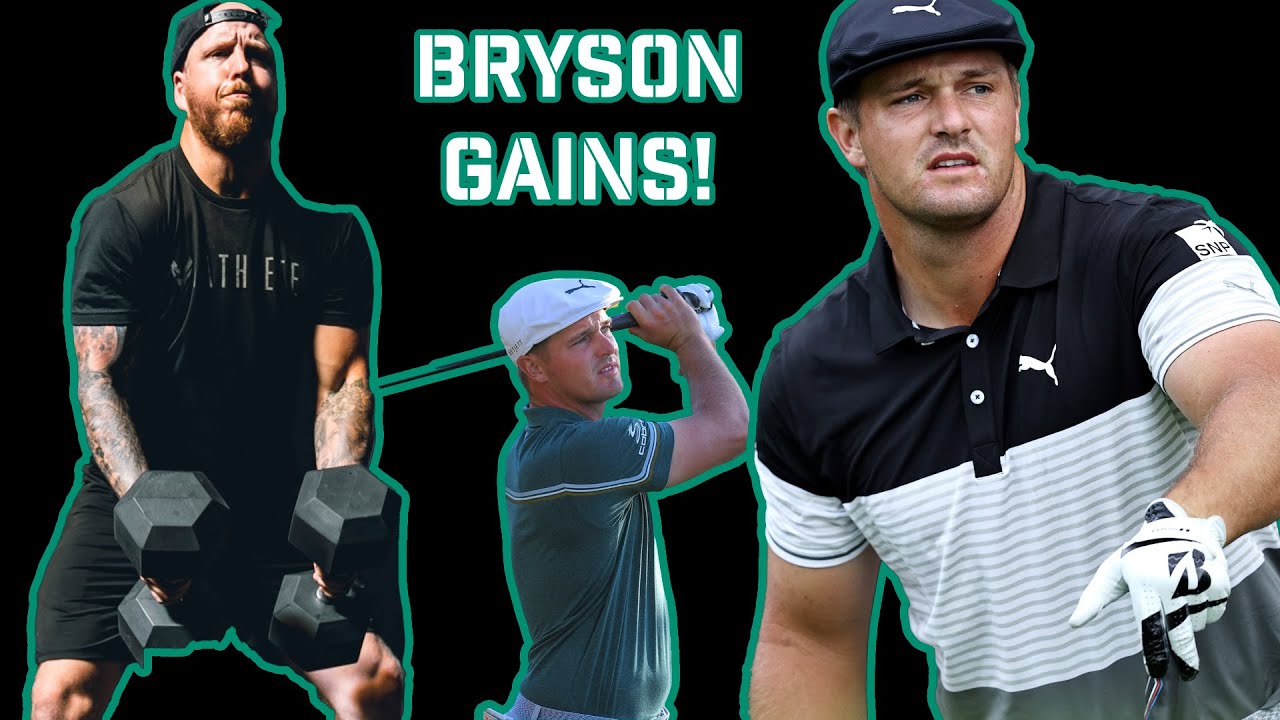
When Bryson DeChambeau showed up to the 2020 season 40 pounds heavier and immediately started striping drives past 340 yards, golf's relationship with fitness changed permanently. The debate shifted from "should golfers train?" to "how much, and what kind?"
But most golfers drew the wrong conclusions. The lesson wasn't "bulk up." It was "your body is the engine." Bryson proved that physical investment produces performance returns. He just did it at an extreme that most recreational golfers don't need — and probably shouldn't attempt.
Here's what his approach actually teaches, stripped of the extremes.
The Core Principle: Mass Moves Mass
DeChambeau's transformation was built on a simple biomechanical idea: more mass, properly trained and coordinated, creates more force. More force through the kinetic chain means more clubhead speed. More clubhead speed means more distance.
He added muscle specifically to the areas that drive the swing: glutes, hamstrings, hips, upper back, and forearms. Not random bulk — targeted mass in the muscles that contribute to the rotational chain.
The principle scales. You don't need to add 40 pounds to benefit from building the muscles that drive your swing. Even modest strength gains in the right areas produce measurable speed increases.
What He Actually Trains
DeChambeau's training has been documented extensively. Across interviews and training footage, several patterns emerge:
Heavy compound lifts for base strength
Deadlifts, squats, bench press, and rows form the foundation of his strength work. These movements build the raw force output that feeds every other quality. Most recreational golfers underinvest here — opting for lighter, "golf-specific" exercises that don't build enough strength to matter.
Speed-focused work with intent
Bryson famously uses speed sticks and overspeed training to directly target clubhead speed — separate from strength work. He treats speed as a trainable skill, not a byproduct of being strong. The two work together: strength gives the muscles more to work with, overspeed training teaches them to fire faster.
Nutrition periodization
The bulk-up phase was deliberate. He ate in a significant caloric surplus while training intensely to maximize muscle gain. Most recreational golfers don't need this — but the principle of fueling training intentionally applies. Golfers who train hard but eat poorly don't adapt at the same rate.
What Recreational Golfers Can Actually Apply
You don't need to restructure your life around training to benefit from DeChambeau's approach. Three takeaways apply at any level:
1. Train the posterior chain seriously
Glutes, hamstrings, and hips generate the power that starts the downswing. Most golfers neglect these in favor of ab work and rotational drills. Deadlifts, hip thrusts, and Romanian deadlifts — done consistently — build the engine behind distance. Two lower body sessions per week, progressive over 6–8 weeks, will move the needle.
2. Train for speed, not just strength
Strength and speed are different physical qualities that require different training stimuli. Strength work alone won't maximize clubhead speed. Add medicine ball rotational throws, plyometric hip extensions, or overspeed training to teach your nervous system to produce force quickly. 10–15 minutes of speed-focused work two days per week is enough to start seeing results.
3. Treat grip strength as a priority
DeChambeau has some of the highest grip strength readings on tour. Grip strength correlates with clubhead speed because the hands are the final point of force transfer to the club. Farmer carries, wrist curls, and heavy dumbbell rows build this without specialty equipment.
The Real Lesson
Bryson DeChambeau didn't discover a secret. He applied a principle that sports science has understood for decades: physical preparation creates performance capacity. He just did it more deliberately, more systematically, and more visibly than anyone in golf had before.
The specific approach — the caloric surplus, the extreme mass gain, the obsessive tracking — isn't the model. The commitment to training as a legitimate performance lever is.
Your swing can only go as fast as your body can move. Your body can only move as fast as you've trained it. That's the takeaway. Not the number on the scale.
Watch
Related Articles
Golf Exercises for Seniors: A Joint-Friendly Routine (With Printable PDF)
A joint-friendly routine of golf exercises and stretches for seniors — eight moves, 15 minutes, no gym required. Includes a free printable PDF to track your reps.
Read
The Off Season Is Where Your Best Golf Is Built
The summer reveals what your body can do. The off season is when you change what that is. Inside the five-phase DRVN progression — Strength, Power, Speed, Biomechanics, Skill Transfer — and what it delivers for three very different golfers.
Read
Golf Posture: The Setup Fundamentals That Unlock Rotation
Correct golf posture isn't a checklist position — it's a product of hip hinge, thoracic extension, and core control. Here's how to build a setup that lasts 18 holes.
Read