
Watch Your Golfer Squat. You'll Learn Everything You Need to Know. — Free Ebook
Before a golfer ever picks up a club, their body is already telling you what their swing is going to do. Download this free DRVN ebook to learn how the Bodyweight Squat Test reveals posture quality, range of motion, thoracic mobility, and ground connection — and what it predicts about their swing.
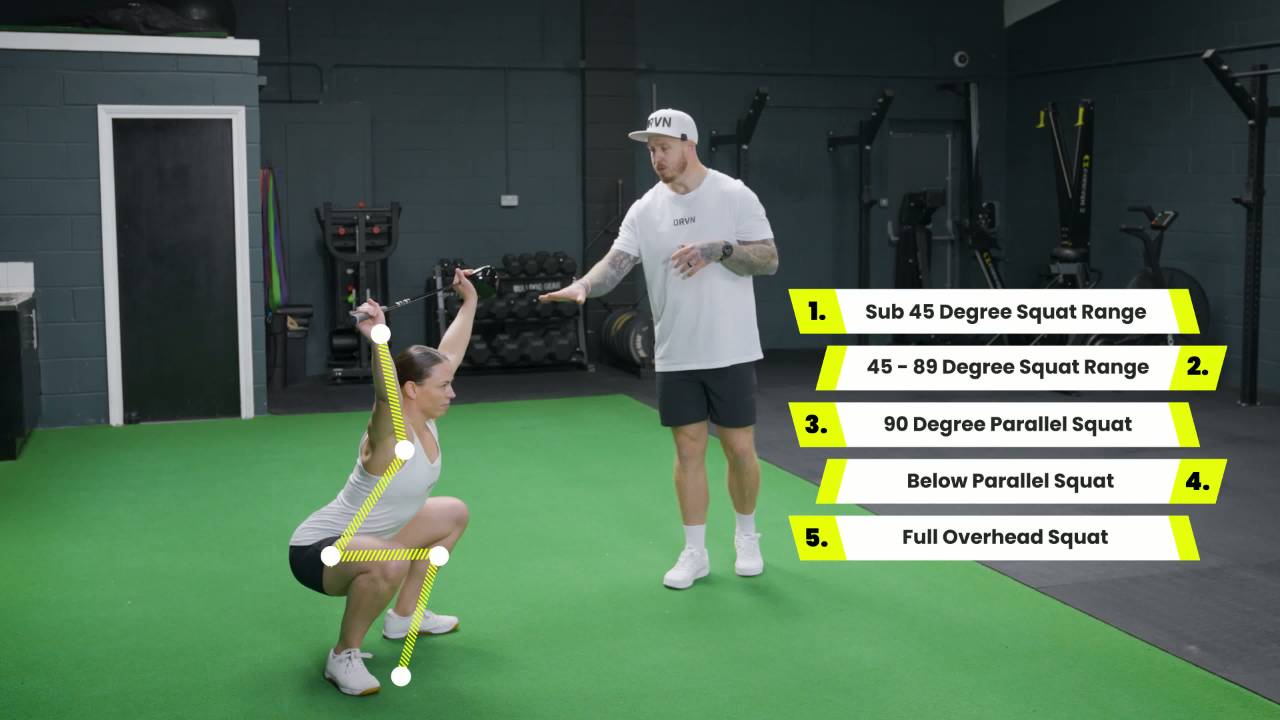
Before a golfer ever picks up a club, their body is already telling you what their swing is going to do. The way they squat — how deep they can go, whether their heels stay flat, how their spine organises under load, what happens to their upper body when their arms go overhead — maps almost directly onto the patterns that appear in their swing.
The Bodyweight Squat Test is one of the most information-dense screens in the DRVN Golf Fitness Handicap™ Mobility Assessment series. In a single movement pattern, it assesses global movement organisation, posture quality, range of motion, ground connection, thoracic mobility, and athletic readiness — all the physical qualities that underpin a consistent, powerful golf swing.
This free DRVN resource breaks it all down: what to look for, what it means, and how it connects to performance.
Why Posture Is the Foundation of Everything in Golf
Posture in golf is not about standing up straight. It is about creating the right athletic organisation — a position from which the body can load, rotate, transfer force, and recover consistently, shot after shot.
When postural quality is high, the swing has a reliable platform to operate from. When it's compromised — through mobility restrictions, poor joint organisation, or an inability to maintain neutral spine under load — every other coaching intervention becomes harder to make stick. Technical adjustments don't hold. Power development is limited. And injury risk increases.
"High quality posture becomes the foundation to improved golf swing fundamentals — ensuring the player is in the best position possible to execute the swing."
The Bodyweight Squat Test gives coaches a direct read on postural quality before a single swing has been taken. And because the squat is a global movement pattern — meaning it challenges the whole system simultaneously — it surfaces restrictions and compensations that isolated assessments can miss.
What the Test Is Actually Measuring
The DRVN Bodyweight Squat Test assesses six interconnected physical qualities, each one with a direct line to swing performance:
Neutral Spine
Retaining a neutral spine position is foundational to posture, stability, and almost all athletic movements. During the squat assessment, coaches look for alignment from the hips up through the neck. Any rounding of the lower back, excessive forward lean, or cervical collapse signals a spinal organisation issue that will show up in the golf swing — most commonly as a loss of posture during the downswing or an inability to maintain the address angles through impact.
Feet Flat — Ground Connection
One of the clearest signals in the squat is whether the heels stay connected to the ground throughout the full range of motion. Heel lift indicates restricted ankle dorsiflexion, tight calves, or limited lower leg mobility — all of which directly compromise the golfer's ability to push into the ground effectively. Ground connection is the foundation of the Power Trifecta. A player who can't keep their heels down in a bodyweight squat will struggle to generate and transfer ground reaction forces in the swing.
Range of Motion — The Depth Standard
The DRVN standard for a full squat is the hip passing below the crease of the knee — a 90-degree or deeper hip angle that demonstrates unrestricted range of motion through the lower body. A half squat position (approximately 45 degrees) reveals meaningful mobility restriction. In the swing, limited squat depth typically correlates with a restricted backswing, poor hip loading capacity, and an inability to achieve the postural depth required for athletic address position and dynamic lower body movement through the shot.
Thoracic Mobility — The Overhead Variation
The overhead squat is where the assessment becomes truly comprehensive. By raising the arms overhead while maintaining squat depth and neutral spine, the test challenges thoracic spine mobility and upper body freedom simultaneously. Achieving the overhead squat with full depth and postural integrity earns a 5 out of 5 score in this test — the highest rating in the DRVN Golf Fitness Handicap™ assessment. Thoracic restriction is one of the most common mobility limiters in recreational golfers, and it directly impacts rotation, shoulder turn depth, and the ability to maintain posture through the backswing.
Athletic Posture
Athletic posture over the golf ball is not a rigid position — it is a relaxed, ready preparedness that comes from a body free of mobility restrictions. The squat test reveals whether a player's body is capable of achieving and holding that state. When mobility restrictions are absent, the player can set up in an organised, connected position and create high-quality dynamic movement from the optimal foundation. When restrictions are present, that foundation is compromised before the swing even begins.
Global Movement Organisation
Perhaps the most important thing the squat reveals is how all the segments of the body organise and coordinate together under load. Joint stacking, weight distribution, spinal control, and limb alignment all become visible in a way that isolated assessments don't capture. For a coach, reading global movement quality in the squat is the fastest way to understand a player's physical readiness for golf-specific training and technical development.
What Poor Squat Patterns Predict in the Golf Swing
The squat is predictive. Coaches who understand the connection between squat assessment findings and swing patterns can often diagnose physical root causes before they observe the swing itself. Common correlations include:
- Heel lift in the squat — poor ground connection in the swing, loss of lead heel contact in the backswing, reduced ability to generate ground reaction force
- Loss of neutral spine / lumbar rounding — C-posture at address, loss of posture during the downswing, early extension through impact
- Forward trunk lean / inability to keep chest up — S-posture at address, restricted shoulder turn, over-the-top swing path
- Limited squat depth / hip restriction — narrow backswing arc, poor hip loading, restricted hip turn reducing separation and power
- Failed overhead squat — thoracic restriction limiting shoulder turn depth, poor upper body freedom through the backswing, inability to maintain posture under rotation
Each of these is a physical finding with a swing consequence — and the squat surfaces all of them in under two minutes. That is the value of a well-designed global movement screen.
The Scoring System: Making Assessment Objective
The DRVN Golf Fitness Handicap™ approach to this test is built around an objective scoring framework. The bodyweight squat with full depth and neutral spine establishes a baseline. The overhead variation — requiring full depth, neutral spine, and arms maintained overhead throughout — represents the highest level of movement quality and earns the maximum score.
This scoring structure matters because it makes progress measurable. A player who begins with a half-squat range of motion and heel lift has a clear physical target to train toward. When they achieve a full squat with heels flat and neutral spine, the coach has objective evidence of improved movement capacity — and can expect to see it reflected in their swing and their Golf Fitness Handicap™ score.
Who This Ebook Is For
- Fitness coaches who want a comprehensive global movement screen that reveals posture quality, range of motion, thoracic mobility, and ground connection in a single assessment
- Golf instructors who want to understand the physical root causes of persistent postural swing faults — C-posture, S-posture, loss of posture, early extension — before prescribing technical solutions
- Any coach working within the DRVN Golf Fitness Handicap™ framework who wants to understand the squat assessment's full diagnostic value and scoring structure
This resource is also part of the prerequisite curriculum for the DRVN Certified Pro™ credential — the professional standard for coaches who integrate golf fitness and performance at the highest level.
What You'll Be Able to Do After Reading It
- Administer the bodyweight squat and overhead squat as a structured, scored mobility assessment within the DRVN Golf Fitness Handicap™
- Identify neutral spine breakdown, heel lift, depth restrictions, and thoracic limitations — and connect each finding to specific swing patterns
- Distinguish between a half-squat presentation and a full-depth squat and understand what each score communicates about the player's physical readiness
- Use squat assessment findings to prioritise mobility and movement quality work in your programming before loading the system with power or speed development
- Track measurable improvements in movement quality and connect them to improvements in athletic posture, swing consistency, and Golf Fitness Handicap™ score
"Being athletic over the ball comes down to a relaxed but ready preparedness that comes from a body free of mobility restrictions."
Download the Free Ebook
Improving Golf Swing Mobility with the Bodyweight Squat Test is free. It is part of the DRVN Golf Fitness Handicap™ Mobility Assessment series — a suite of physical screening resources that give coaches the objective data they need to build smarter, more effective golf performance programmes.
The squat is the most globally revealing movement screen in the series. If you only had time to run one assessment on a new golfer client, this would be it.
Organise the body. Build the posture. Free the swing.
Related Articles
Understanding Golf Ball Measurements for Applied Progressions — Free Ebook
Most fitness coaches never look at the ball. DRVN Certified Pros do. Download this free ebook to learn how ball flight data connects to physical training protocols — and how to coach golfers at a higher level.
Read
Understanding Golf Club Measurements for Applied Progressions — Free Ebook
Club head speed is a body problem. Download this free ebook to learn how club data connects to physical training — and how to use swing metrics to build faster, more accurate progressions for your golfer clients.
Read
Understanding Golf Swing Biomechanics to Build a New Swing Concept — Free Ebook
How ground reaction forces, kinematic sequencing, and the coil-uncoil mechanism create a faster, more consistent golf swing — with a free ebook guide.
Read