
Understanding Golf Swing Biomechanics to Build a New Swing Concept — Free Ebook
How ground reaction forces, kinematic sequencing, and the coil-uncoil mechanism create a faster, more consistent golf swing — with a free ebook guide.

Here's what most golfers and coaches get wrong: they treat the golf swing as a technique problem. Grip, stance, takeaway, plane — endless adjustments, chasing a feeling that disappears by the next round.
The third free resource in the DRVN Digital Training Curriculum reframes all of that. Understanding Golf Swing Biomechanics to Build a New Swing Concept teaches coaches — fitness and golf alike — how to build a golf swing from the ground up, using the body's own force production system as the foundation.
This isn't swing theory. It's applied biomechanics. And it changes everything about how you coach.
Everything Starts From the Ground
The ebook opens with a foundational premise that shapes every concept that follows: all movement comes from the ground. Through connection to the ground, pressure shifts, and efficient management of center of gravity, a player can build a powerful, well-sequenced golf swing from the ground up.
That single idea reorients the entire coaching framework. Before you can talk about club path, face angle, or ball flight, you need a stable, organized lower body foundation that allows everything above it to function at full potential.
Lower Body Stability
The lower body acts as the anchor that everything else rotates around. The ebook introduces the concept of joint organization — stacking joints to create an active, connected system that sets a stable base for pressure shifts, power development, and a consistent center of gravity. When that foundation is compromised, every segment above it is forced to compensate.
Centre of Gravity (COG)
Every movement has a center, and in the golf swing, managing that center under high rotational forces is what separates consistent ball strikers from erratic ones. Lateral movement must stay within the base of support — mass between the feet — to deliver a repeatable bottom of the arc position. COG control is a trainable physical skill, not a swing thought.
Neutral Spine
The upper body rotates roughly twice as far as the lower body during a full swing. To do that efficiently, the spine needs to maintain a neutral, organized position throughout — one that allows the upper body to coil against lower body stability, loading joints and creating the elastic potential that ultimately powers the shot.
The Coil-Uncoil Mechanism: Where Power Actually Comes From
One of the most practically useful sections of the ebook is its breakdown of the coil-uncoil mechanism — the physical process by which the golf swing stores and releases energy.
"During the backswing, the trail side stabilises as the lead side 'coils' around that stability, stretching musculature that will then contract and shorten, creating the 'uncoiling' feel of high-powered rotation."
This is stretch-shortening cycle mechanics applied directly to golf. The backswing isn't just a positioning exercise — it's an energy-loading phase. The better a player can create and hold that separation between upper and lower body, the greater their force potential going into the downswing.
Segmented Rotation and Separation
Separation — the differential between upper and lower body rotation — is one of the primary differentiators between performance levels. The greater a player's ability to increase separation, the greater their potential for both physical and technical performance. This is a trainable quality. It's also a measurable one.
Ground Reaction Forces
As the body loads into the trail side on the backswing, it builds ground reaction force. The transition — the shift of pressure into the lead foot — is what triggers the uncoiling sequence and amplifies power potential. Loading into the trail side correctly, and transitioning efficiently, is one of the highest-leverage coaching interventions available. It's also almost entirely a physical capacity question.
The Power Trifecta: Three Sources, One Swing
The ebook introduces one of DRVN's most distinctive frameworks: the Power Trifecta. The golf swing has three distinct power sources, and understanding all three — and how they interact — is essential for any coach who wants to maximize a player's force potential:
- Lateral — The weight shift and pressure movement that initiates the downswing sequence
- Rotational — The segmented rotation of the hips, torso, and shoulders through the ball
- Vertical — The push through the ground that amplifies club head speed at impact
DRVN's coaching system develops stability and force creation applied sequentially — which not only maximizes performance potential but also decreases injury risk by keeping the mechanics aligned with natural human movement patterns.
Kinematic Sequencing: The Right Force at the Right Time
Power without sequencing is wasted energy. That's the core insight behind the ebook's treatment of kinematic sequencing — arguably the most important concept in high-performance golf coaching.
"One of the biggest flaws golfers struggle with is applying force incorrectly — and often, too early."
When kinematic sequencing is in place, force is applied through the transition and the body uncoils in the correct order, allowing the club head to freely release through the ball at maximal speed and efficiency. The sequencing order is non-negotiable:
Legs → Hips → Torso → Arms → Hands → Club
The club head is the final element of the sequence — the destination of all the force that has been built, organized, and transferred through the body. Any breakdown in that chain leaks speed. Any improvement in that chain adds it.
This is where fitness training and technical coaching converge most powerfully. Range of motion, rotational strength, stability, and power development aren't just gym qualities — they directly determine whether a player can execute kinematic sequencing under the demands of a full-speed swing.
The DRVN Coaching Pathway: From Foundation to Performance
The ebook closes with a clear, sequenced framework for how to build a player from the ground up. This is the DRVN Coaching Pathway — four progressive stages that structure every coaching intervention:
- Build the Foundation — Establish lower body stability, joint organization, COG control, and neutral spine mechanics. Without this, nothing else holds.
- Improve Movement Capacity — Develop the range of motion, mobility, and physical qualities that allow the swing to express its full potential without compensation.
- Increase Power and Speed Potential — Build force production across the Power Trifecta: lateral, rotational, and vertical. Develop the coil-uncoil mechanism and ground reaction force application.
- Optimise Fundamentals and Biomechanics — Apply technical coaching on top of a body that is now physically capable of executing it. Align the swing to the body's optimal movement pattern.
"Instead of chasing quick fixes, we understand and deliver the most impactful coaching right now and into the future."
Who This Ebook Is For
- Fitness coaches who want to understand how the physical qualities they train — stability, rotational power, mobility, ground force production — directly translate into swing performance
- Golf instructors who want a biomechanical framework to underpin their technical coaching, so the fixes they prescribe actually stick
- Any performance coach who has ever given a golfer advice that worked in the lesson and disappeared by Saturday morning
This ebook is also part of the prerequisite curriculum for the DRVN Certified Pro™ credential — the professional certification for coaches who integrate golf fitness and technical performance at the highest level.
What You'll Be Able to Answer After Reading It
- Why does a golfer lose power at the top of the backswing — and is it a technique issue or a mobility issue?
- What is kinematic sequencing and how do I train a golfer to achieve it?
- How do ground reaction forces affect club head speed and distance?
- What does 'coil and uncoil' actually mean physically — and how do I develop it in training?
- Why do some golfers hit it farther with less apparent effort — and how can I replicate that?
- How does center of gravity affect swing consistency and ball striking?
- What is the correct order of force application in the golf swing?
Download the Free Ebook
Understanding Golf Swing Biomechanics to Build a New Swing Concept is free. It's the third guide in the DRVN Digital Training Curriculum — a growing series of resources covering every fundamental of integrated golf performance coaching.
Build the body. Build the swing. In that order.
Related Articles
Understanding Golf Ball Measurements for Applied Progressions — Free Ebook
Most fitness coaches never look at the ball. DRVN Certified Pros do. Download this free ebook to learn how ball flight data connects to physical training protocols — and how to coach golfers at a higher level.
Read
Understanding Golf Club Measurements for Applied Progressions — Free Ebook
Club head speed is a body problem. Download this free ebook to learn how club data connects to physical training — and how to use swing metrics to build faster, more accurate progressions for your golfer clients.
Read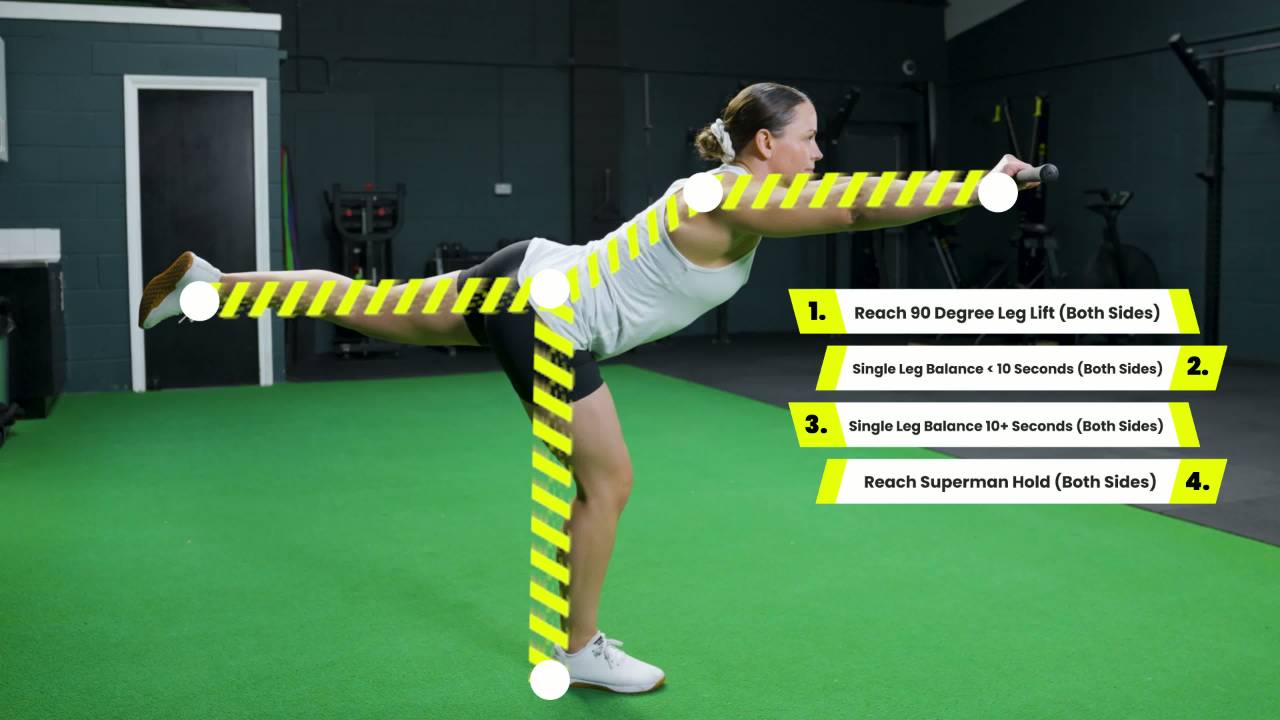
Can Your Golfer Stand on One Leg? The Single Leg Balance Test — Free Ebook
The Single Leg Balance Test reveals proprioception deficits, hip flexor dysfunction, and stability limitations that directly affect swing consistency and power. Download this free DRVN ebook to learn how to administer it, read the results, and connect them to your coaching.
Read