
Understanding Golf Club Measurements for Applied Progressions — Free Ebook
Club head speed is a body problem. Download this free ebook to learn how club data connects to physical training — and how to use swing metrics to build faster, more accurate progressions for your golfer clients.

Every golfer wants more distance. And almost every coach — fitness or golf — knows that distance starts with club head speed. But knowing that fact and knowing what to do about it are two very different things.
The second free resource in the DRVN Digital Training Curriculum — Understanding Golf Club Measurements for Applied Progressions — is built to close that gap. It gives coaches the objective data framework to measure what the club is doing at impact, understand why, and trace it directly back to the body.
If you work with golfers and you're not fluent in club data, this is your starting point.
The Body Moves the Club. Full Stop.
That's the central thesis of this ebook — and it's the lens through which every metric is taught. Club head speed, smash factor, angle of attack, club path, face angle: none of these are abstract technical numbers. They are direct outputs of how a body moves.
"Your body moves the club and therefore your movement patterns and technical specifics define what the club does at impact."
This is what makes club data so powerful for fitness coaches. You don't need to be a PGA instructor to use these numbers. You need to understand what physical qualities drive them — and how to train those qualities more effectively.
Understanding key parameters and data gives you objective benchmarks to set goals, track progress, and deliver consistent improvement over time. That's not a golf coach's advantage. That's every performance coach's advantage.
The 5 Club Metrics That Matter Most
The ebook breaks down five core swing data points — each one a window into a specific physical quality that can be trained:
1. Club Head Speed
The velocity of the club head at impact. Higher club head speed creates greater distance potential — but speed without control is just chaos. The ebook frames club head speed as the product of three physical qualities working together: stability, force potential, and kinematic sequencing. All three are trainable. All three are testable.
2. Smash Factor
The ratio of ball speed to club head speed — a direct measure of energy transfer efficiency. A golfer can swing hard and still leave yards on the table if their smash factor is low. Improving smash factor means building a more repeatable swing pattern grounded in efficient biomechanics. It's the difference between raw power and applied power.
3. Angle of Attack
Whether the club is moving upward or downward at the moment of impact. For driver, a positive (upward) angle of attack optimizes launch conditions and reduces spin. For irons, a downward strike is typically preferred. Angle of attack is influenced by swing arc, ball position, and center of gravity — all of which connect directly to postural stability and mobility in the golf-specific positions.
4. Club Path
The direction the club travels through impact relative to the target line. An in-to-out path produces draw-biased shots; out-to-in produces fades or slices. Club path is directly impacted by range of motion and kinematic sequencing — which means a restricted hip turn, limited thoracic rotation, or poor sequencing pattern will show up in the data before it ever shows up in a coaching conversation.
5. Face Angle
Where the clubface is pointing at impact — the single biggest determinant of the ball's starting direction. Face angle is the end result of everything that happens in the swing. When you understand what drives face angle, you can work backward to the physical and technical root causes, rather than chasing symptoms.
Impact: Where Biomechanics Meet Technical Fundamentals
One of the most valuable sections of this ebook is its focus on impact factors — the exact confluence of forces and positions that produce the shot outcome. The ebook references real Foresight launch monitor data to show what elite impact actually looks like across multiple data points simultaneously.
This matters because impact isn't a single variable. It's ball speed, club head speed, efficiency, carry, total distance, offline deviation, closure rate, side angle, sidespin, launch angle, backspin — all happening in a fraction of a second. Coaches who can read this data holistically can diagnose faster, intervene more precisely, and track progress with real objectivity.
"Creating the specifics of impact is what takes a large amount of focused practice to improve and is the moment of truth in golf. This is where biomechanics meet technical fundamentals to create the shot outcome."
Linking Club Data to Physical Training
The final section of the ebook — Linking Biomechanics — is what separates this resource from anything a golfer could find online. It explicitly connects each club metric back to the physical qualities a fitness coach is already trained to develop:
- Launch angle connects to dynamic loft, swing arc, ball position, and center of gravity — all influenced by posture, hip mobility, and ground force application
- Club path connects directly to range of motion and kinematic sequencing — the physical domains that define how efficiently the body rotates through the swing
- Smash factor connects to swing repeatability — which is built on a foundation of efficient biomechanics, not just practice volume
- Club head speed connects to stability, force potential, and kinematic sequencing — the three-pillar framework DRVN uses to structure physical performance training for golfers
When you understand how physical qualities map to club metrics, every training session becomes a deliberate investment in measurable on-course performance.
Who This Ebook Is For
- Fitness coaches who train golfers and want to speak the language of swing data — connecting strength, mobility, and power development to specific, measurable club metrics
- Golf instructors who want a deeper understanding of the physical root causes behind the data they're already collecting on the range
- Any performance professional who wants to build more systematic, data-informed training progressions for golfer clients
This ebook is also part of the prerequisite curriculum for the DRVN Certified Pro™ credential — the certification that formally recognizes coaches who can integrate fitness and golf performance at the highest level.
What You'll Be Able to Answer After Reading It
- What physical qualities drive club head speed — and how do I train them?
- How do I improve a golfer's smash factor through better biomechanics?
- What does a poor club path tell me about a client's range of motion or sequencing?
- How does angle of attack connect to a golfer's hip mobility and postural stability?
- How do I read launch monitor data as a fitness coach without a swing background?
- What is kinematic sequencing and why does it matter for distance and accuracy?
These aren't fringe questions. They're the questions separating good coaches from elite ones — and they're all answerable once you understand the connection between body and club.
Download the Free Ebook
Understanding Golf Club Measurements for Applied Progressions is free. It's the second guide in the DRVN Digital Training Curriculum — a growing series covering every fundamental of data-driven golf performance coaching.
The club doesn't lie. Neither does the data. Learn to read both.
Related Articles

Understanding Golf Ball Measurements for Applied Progressions — Free Ebook
Most fitness coaches never look at the ball. DRVN Certified Pros do. Download this free ebook to learn how ball flight data connects to physical training protocols — and how to coach golfers at a higher level.
Read
Understanding Golf Swing Biomechanics to Build a New Swing Concept — Free Ebook
How ground reaction forces, kinematic sequencing, and the coil-uncoil mechanism create a faster, more consistent golf swing — with a free ebook guide.
Read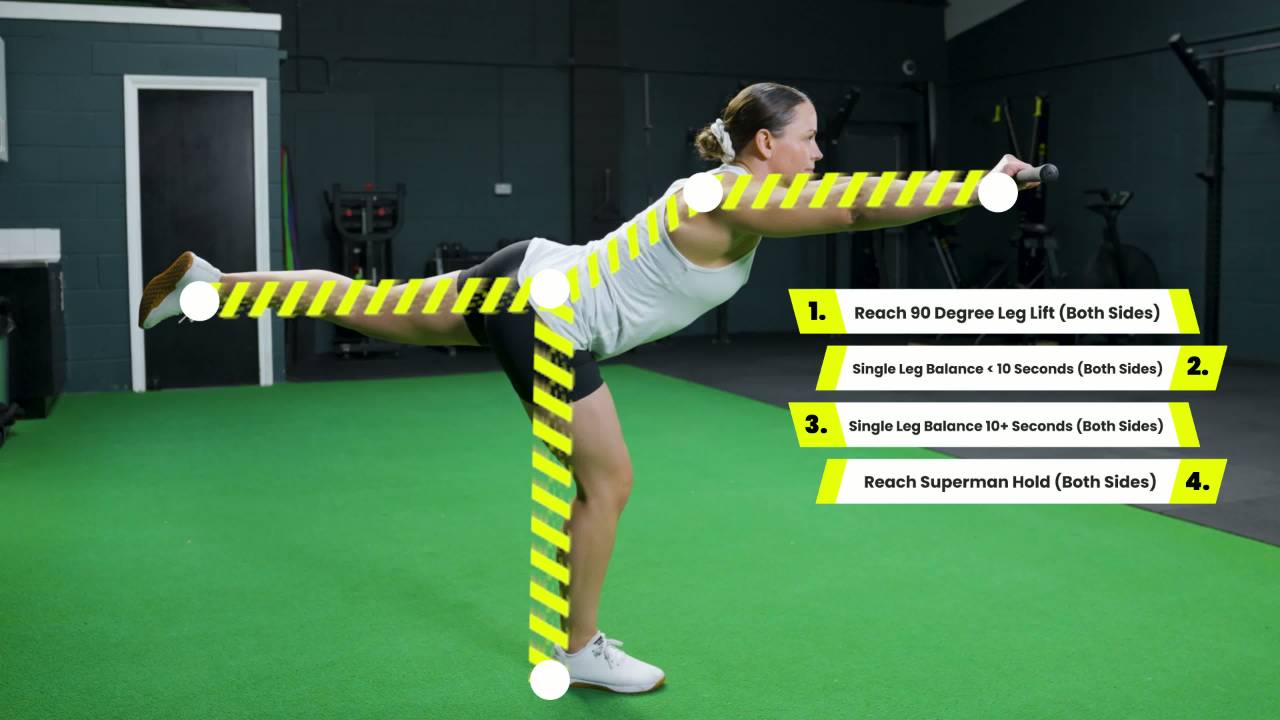
Can Your Golfer Stand on One Leg? The Single Leg Balance Test — Free Ebook
The Single Leg Balance Test reveals proprioception deficits, hip flexor dysfunction, and stability limitations that directly affect swing consistency and power. Download this free DRVN ebook to learn how to administer it, read the results, and connect them to your coaching.
Read