
Can Your Golfer Stand on One Leg? The Single Leg Balance Test — Free Ebook
The Single Leg Balance Test reveals proprioception deficits, hip flexor dysfunction, and stability limitations that directly affect swing consistency and power. Download this free DRVN ebook to learn how to administer it, read the results, and connect them to your coaching.
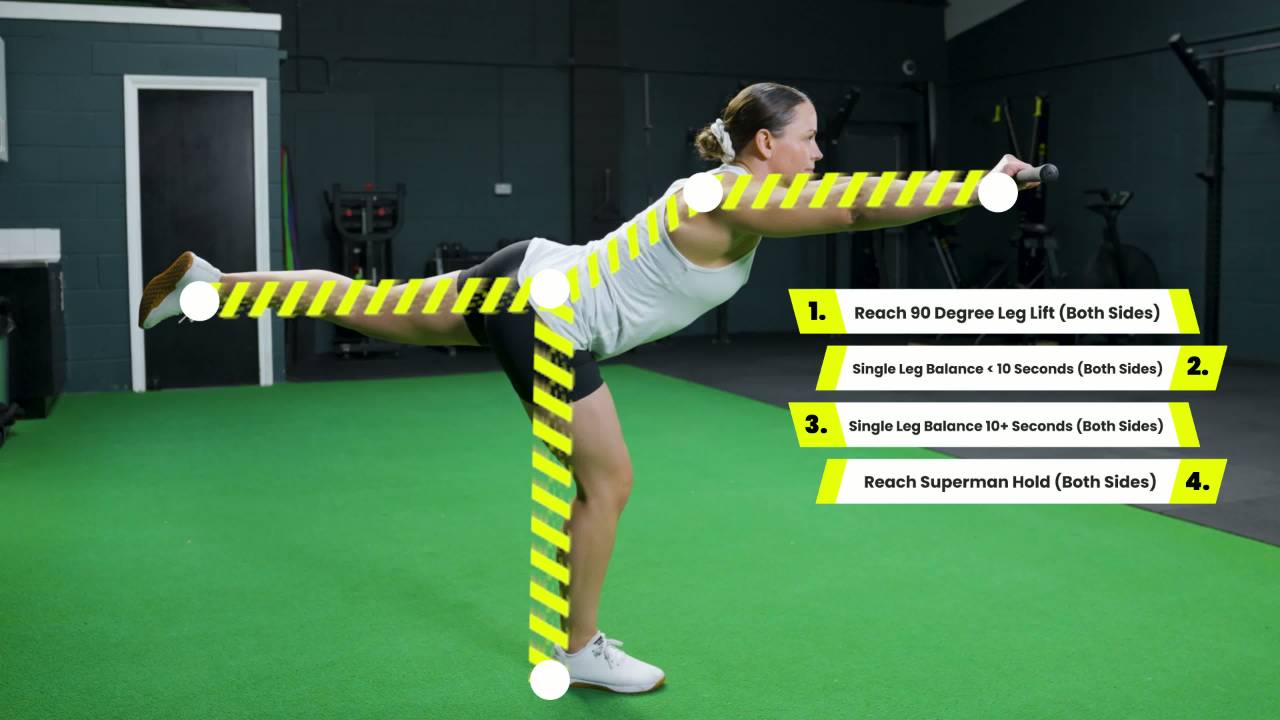
It sounds almost too simple. Stand on one leg. Raise the opposite hip to 90 degrees. Hold it.
But the Single Leg Balance Test — one of the key mobility assessments in the DRVN Golf Fitness Handicap™ — is one of the most revealing physical screens a coach can run on a golfer. In about 60 seconds, it surfaces proprioception deficits, hip flexor dysfunction, footwork breakdowns, and stability limitations that directly predict swing consistency, power transfer, and injury risk.
This free DRVN resource breaks the test down completely — what you're assessing, what you're seeing, and how it connects to every phase of the golf swing.
Why Balance Is a Golf Performance Issue
Balance isn't a warm-up exercise or a rehabilitation concept. In the golf swing, balance is the infrastructure that everything else is built on. Every aspect of the swing — from the backswing coil to the transition to impact — requires a high level of stability, balance, and body awareness to be consistent in terms of biomechanics, skill acquisition, and applied performance.
When that infrastructure is compromised, the body compensates. The player loses control of their center of gravity. Swing patterns become inconsistent. Club path, face angle, and impact position all drift — not because the golfer's technique is failing, but because their physical foundation isn't stable enough to support it.
"Every aspect of the swing requires a high level of stability, balance, and awareness to be consistent in terms of biomechanics, skill acquisition, and application of that skill."
The Single Leg Balance Test gives coaches an objective baseline for that foundation — and a measurable target to train toward.
What the Test Is Actually Measuring
The ebook identifies five interconnected physical qualities that the Single Leg Balance Test simultaneously assesses:
Proprioception
Proprioception is a player's awareness of their body in space — and it is a defining factor in balance overall. In golf terms, proprioception is what allows a player to feel the club, manage pressure shifts, and develop the kind of repeatable swing feel that holds up under competition conditions. Coaches can observe proprioceptive deficits directly in how a player manages — or fails to manage — micro-adjustments during the hold.
Hip Mobility
A key component of the test is the ability to raise the hip to 90 degrees and hold it in balance. Tight or dysfunctional hip flexors make this significantly harder than it should be — and hip flexor restriction is one of the most common physical limiters in the golf population. The test also incorporates the Superman Hold hinge pattern, which challenges hip mobility in the posterior chain and directly mirrors the athletic posture required at address and through impact.
Footwork
The standing foot is doing significant work during the test — actively engaging the ground to provide a stable base for everything above it. This mirrors what happens in the golf swing on every shot. Movement and micro-adjustment during the hold is normal, but major shifts in center of gravity reveal inconsistent foot mechanics. Poor footwork under static conditions reliably predicts poor footwork under the dynamic demands of a full swing.
Stability Under Load
The test challenges the body's ability to maintain overall system stability while one segment is elevated and loaded. This replicates the demands of the golf swing's pressure transfer phases — particularly the trail side load on the backswing and the lead side landing in the downswing. A player who can't stabilize under the relatively low load of a single leg hold will struggle to do it at swing speed.
Feel and Body Awareness
The ebook makes an important coaching point about feel: improving movement quality and awareness through this kind of work doesn't just build physical capacity — it builds the sensory feedback system that golfers use to control their swing. As proprioception improves, feel improves. As feel improves, confidence and performance follow.
How This Connects to the DRVN Golf Fitness Handicap™
The Single Leg Balance Test is part of the DRVN Golf Fitness Handicap™ Mobility Assessment — a suite of standardized physical screens that give coaches an objective picture of a golfer's movement capacity before any training or technical intervention begins.
The Golf Fitness Handicap™ is a core component of the DRVN system: a measurable, repeatable baseline that allows coaches to track physical progress, align training priorities, and connect fitness improvements directly to on-course performance outcomes. Rather than guessing where a player's physical limitations are, the assessment tells you — with data.
The balance test feeds directly into that picture. It surfaces deficits in stability, hip mobility, footwork, and proprioception that show up in the swing whether or not the player or coach can articulate them.
What Poor Balance Looks Like in the Swing
Coaches who can connect balance assessment results to swing observations become dramatically more effective. Here's what the data typically predicts:
- Excessive lateral sway on the backswing — often a center of gravity control failure rooted in single-leg stability deficits
- Loss of posture through impact — frequently linked to poor hip mobility limiting the ability to maintain address angles under rotation
- Inconsistent bottom of arc — a direct result of footwork instability causing the swing center to drift
- Early extension — often a compensation for the player's inability to stabilize the lower body against the rotational forces of the downswing
- Thin and fat contact patterns — typically traceable to poor proprioception and ground connection during the swing
None of these are purely technique problems. They are physical problems with technical consequences — and the Single Leg Balance Test is one of the fastest ways to identify them.
Who This Ebook Is For
- Fitness coaches who want a simple, equipment-free assessment tool to establish a golfer's physical baseline before programming begins
- Golf instructors who want to understand why certain swing faults recur despite repeated technical intervention — and how physical screening can explain them
- Any coach working with the DRVN Golf Fitness Handicap™ system who wants to understand what the balance assessment is capturing and why it matters
This resource is also part of the prerequisite curriculum for the DRVN Certified Pro™ credential — the professional standard for coaches who integrate golf fitness and performance coaching at the highest level.
What You'll Be Able to Do After Reading It
- Administer the Single Leg Balance Test as a structured, objective assessment — not just a drill
- Identify proprioception deficits and connect them to specific swing patterns
- Diagnose hip flexor restriction through the test and prioritise it in your programming
- Read footwork quality under static load and predict how it will express itself under dynamic swing conditions
- Use balance assessment data as part of the DRVN Golf Fitness Handicap™ to set baselines and track measurable progress
"As we improve movement quality and awareness, we can enhance feel — and therefore confidence and performance — more often at all levels."
Download the Free Ebook
Improving Golf Swing Mobility with the Single Leg Balance Test is free. It's part of the DRVN Golf Fitness Handicap™ Mobility Assessment Series — a collection of resources covering the physical screens that form the foundation of the DRVN coaching system.
If you coach golfers and you're not using movement assessments to guide your programming, this is where to start. One test. Five physical qualities. Enormous coaching clarity.
Know the body. Fix the swing. Measure the result.
Related Articles
Understanding Golf Ball Measurements for Applied Progressions — Free Ebook
Most fitness coaches never look at the ball. DRVN Certified Pros do. Download this free ebook to learn how ball flight data connects to physical training protocols — and how to coach golfers at a higher level.
Read
Understanding Golf Club Measurements for Applied Progressions — Free Ebook
Club head speed is a body problem. Download this free ebook to learn how club data connects to physical training — and how to use swing metrics to build faster, more accurate progressions for your golfer clients.
Read
Understanding Golf Swing Biomechanics to Build a New Swing Concept — Free Ebook
How ground reaction forces, kinematic sequencing, and the coil-uncoil mechanism create a faster, more consistent golf swing — with a free ebook guide.
Read