
Your Golfer's Lower Back Pain, Power Leaks, and Swing Inconsistency Have the Same Root Cause — Free Ebook
Glute dysfunction is one of the most common — and most underdiagnosed — physical limiters in the golf population. Download this free DRVN ebook to learn how the Glute Activation Test surfaces posterior chain deficits and asymmetry that directly explain swing faults, power loss, and lower back pain.
Glute dysfunction is one of the most common — and most underdiagnosed — physical limiters in the golf population. Tight hip flexors, inhibited glutes, and left-right asymmetry in posterior chain activation quietly undermine swing power, postural stability, and impact consistency. And most golfers have no idea it's happening.
The Glute Activation Test — part of the DRVN Golf Fitness Handicap™ Mobility Assessment series — gives coaches a simple, repeatable screen to identify exactly this. This free resource breaks down what the test measures, what you're looking for, and why it matters so fundamentally to golf performance.
Why Glute Function Is a Golf Issue, Not Just a Fitness Issue
Ask most golfers about their glutes and they'll nod along. Ask them whether their glutes are actually activating correctly in their swing — and the answer is almost always: they don't know.
The glutes are the largest and most powerful muscle group in the body. In the golf swing, they are responsible for pelvic stability, hip rotation, ground force transmission, and the separation between upper and lower body that drives power. When they're not activating properly — or activating asymmetrically — the body compensates. The lower back picks up the load. The swing loses sequencing. Power leaks out of the system.
"Improving hip hinge capacity, glute strength and function alongside flexibility in the hip flexors will help all movement patterns and power output — whilst also reducing injury risk throughout the body, specifically the lower back."
The Glute Activation Test makes the invisible visible. It gives coaches objective data on whether the glutes are firing, how well they're engaging the ground, and whether there's a meaningful asymmetry between sides that is silently costing the player distance and consistency.
What the Test Is Actually Measuring
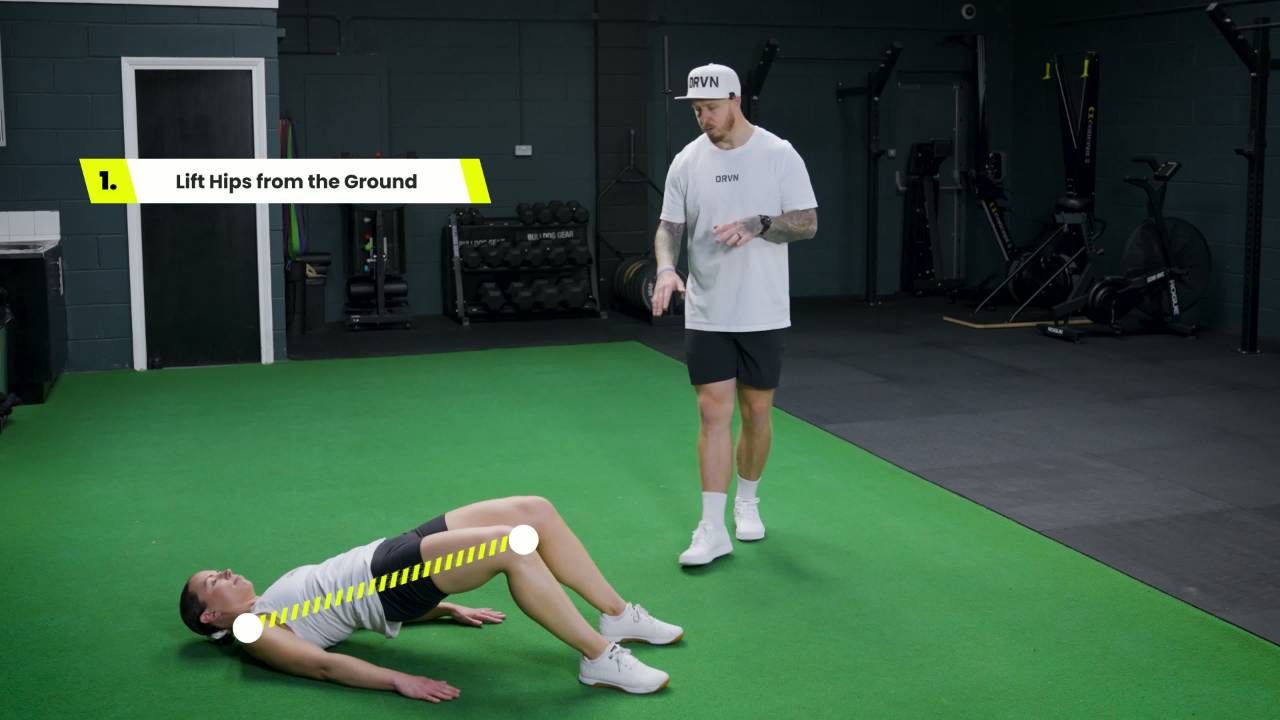
The DRVN Glute Activation Test uses the glute bridge and its single-leg variation to assess five interconnected physical qualities — all of which connect directly to swing performance:
Glute Function
The test evaluates the glutes' ability to activate under load — specifically their capacity to extend the hip fully against the ground. A player who cannot achieve and hold a strong glute bridge is almost certainly compensating in their swing: overusing the lower back, losing postural depth, or failing to generate the hip extension force that drives rotational power. Improving hip hinge capacity and hip flexor flexibility directly unlocks glute function — and both are trainable.
Connection to the Ground
The bilateral bridge position assesses how well a player can leverage the ground as a platform for force production. The connection of shoulders and feet creates the foundation from which the glutes engage. This mirrors what happens in the swing: a player's ability to push into the ground — particularly through the lead foot in the downswing — depends on this same ground-connection mechanic being present and reliable.
Asymmetry — The Single-Leg Variation
This is where the test becomes most diagnostic. The single-leg glute bridge reveals imbalances in glute activation between the left and right sides — imbalances that are directly correlated with both power output and injury prevention. A player with significantly weaker glute activation on one side will compensate in the swing, often showing as lateral sway, early extension, or a loss of lead-side stability through impact. This asymmetry is rarely obvious from watching a swing alone. The test surfaces it in seconds.
Postural Retention
The ebook frames posture as a performance variable, not just an aesthetic one. The body's ability to retain posture — matched with the swing arc moving freely around the body — is what delivers the club into impact consistently. Glute dysfunction directly compromises postural stability: when the glutes aren't holding the pelvis level and controlled, the spine tilts, the swing center moves, and impact factors become unpredictable. The bridge test reveals whether the posterior chain can hold the positions the swing demands.
Separation and Sequencing Capacity
When a player can separate their upper and lower body effectively, they can sequence the swing correctly and create a swing arc that delivers consistency and the desired outcome. Glute restriction — whether through weakness, inhibition, or asymmetry — is one of the primary physical reasons players cannot achieve proper separation. The test gives coaches early visibility into whether this limitation is present before it shows up as a persistent swing fault.
The Asymmetry Problem: Why One Side Matters as Much as Both
One of the most valuable aspects of this assessment is the emphasis on side-to-side asymmetry. In most physical screens for golf, bilateral tests tell you something. But the single-leg variation tells you something more specific and more actionable.
Golf is a rotationally asymmetric sport. The lead glute and trail glute play different roles in the swing — and if one side is significantly underperforming, the player will compensate. Common compensations include:
- Reverse pivot — the player falls toward the target on the backswing because the trail glute can't stabilise the pelvis
- Lead-side collapse through impact — the lead glute isn't strong enough to resist the rotational forces of the downswing
- Lower back overuse — the lumbar spine takes on load that the glutes should be absorbing, creating both performance loss and injury risk
- Loss of swing arc width — the player can't maintain posture because the posterior chain isn't providing a stable base
None of these are purely technical faults. They are physical expressions of a physical problem — and the Glute Activation Test identifies them at the source.
How This Connects to the DRVN Golf Fitness Handicap™
The Glute Activation Test is one of the standardized physical screens in the DRVN Golf Fitness Handicap™ Mobility Assessment. Alongside the Single Leg Balance Test and other assessments in the series, it gives coaches a comprehensive physical baseline for every golfer they work with.
That baseline matters because it makes coaching systematic. Instead of observing a swing fault and guessing whether it's physical or technical, coaches using the DRVN Golf Fitness Handicap™ have data. They know which physical qualities are limiting performance. They know which side is weaker. They know what to train first — and they can measure whether the training is working.
Glute activation is not a box to tick in a warm-up. It is a measurable performance variable. The DRVN system treats it that way.
Who This Ebook Is For
- Fitness coaches who train golfers and want a reliable screen for posterior chain dysfunction that connects directly to swing performance
- Golf instructors who see persistent lower body faults — reverse pivot, early extension, lead-side collapse — and want to understand the physical root cause
- Any performance coach working within the DRVN Golf Fitness Handicap™ framework who wants to understand what the glute assessment is capturing and how to apply the findings
This resource is also part of the prerequisite curriculum for the DRVN Certified Pro™ credential — the professional standard for coaches who integrate golf fitness and performance at the highest level.
What You'll Be Able to Do After Reading It
- Administer the bilateral and single-leg glute bridge test as a structured mobility assessment within the DRVN Golf Fitness Handicap™
- Identify glute inhibition and hip hinge deficits and connect them to specific swing compensation patterns
- Detect left-right asymmetry in glute activation and understand its implications for swing power and injury prevention
- Prioritise hip flexor flexibility and glute strengthening in programming based on clear assessment findings
- Communicate glute activation findings to golfers in a way that connects physical training directly to performance outcomes they can feel and measure
"When the player can separate effectively, they can also sequence and create a swing arc that brings consistency and desired outcomes. Restriction in this area will inhibit performance through movement quality and power potential."
Download the Free Ebook
Improving Golf Swing Mobility with the Glute Activation Test is free. It's part of the DRVN Golf Fitness Handicap™ Mobility Assessment series — a collection of practical screening resources that form the physical assessment foundation of the DRVN coaching system.
If your golfer clients struggle with lower back tightness, inconsistent power, or swing faults that technical coaching hasn't resolved, there's a strong chance the glutes are part of the story. This ebook shows you how to find out — and what to do about it.
Activate the glutes. Stabilise the pelvis. Unlock the swing.
Related Articles
Understanding Golf Ball Measurements for Applied Progressions — Free Ebook
Most fitness coaches never look at the ball. DRVN Certified Pros do. Download this free ebook to learn how ball flight data connects to physical training protocols — and how to coach golfers at a higher level.
Read
Understanding Golf Club Measurements for Applied Progressions — Free Ebook
Club head speed is a body problem. Download this free ebook to learn how club data connects to physical training — and how to use swing metrics to build faster, more accurate progressions for your golfer clients.
Read
Understanding Golf Swing Biomechanics to Build a New Swing Concept — Free Ebook
How ground reaction forces, kinematic sequencing, and the coil-uncoil mechanism create a faster, more consistent golf swing — with a free ebook guide.
Read