
The X-Factor Is Real. Here's How to Measure It. — Free Ebook
The Split Stance Rotation Test measures separation, hip rotation, core activation, and single-leg stability under asymmetric load — the exact demands of the golf swing. Download this free DRVN ebook to learn how to quantify the X-Factor and connect it directly to your coaching.
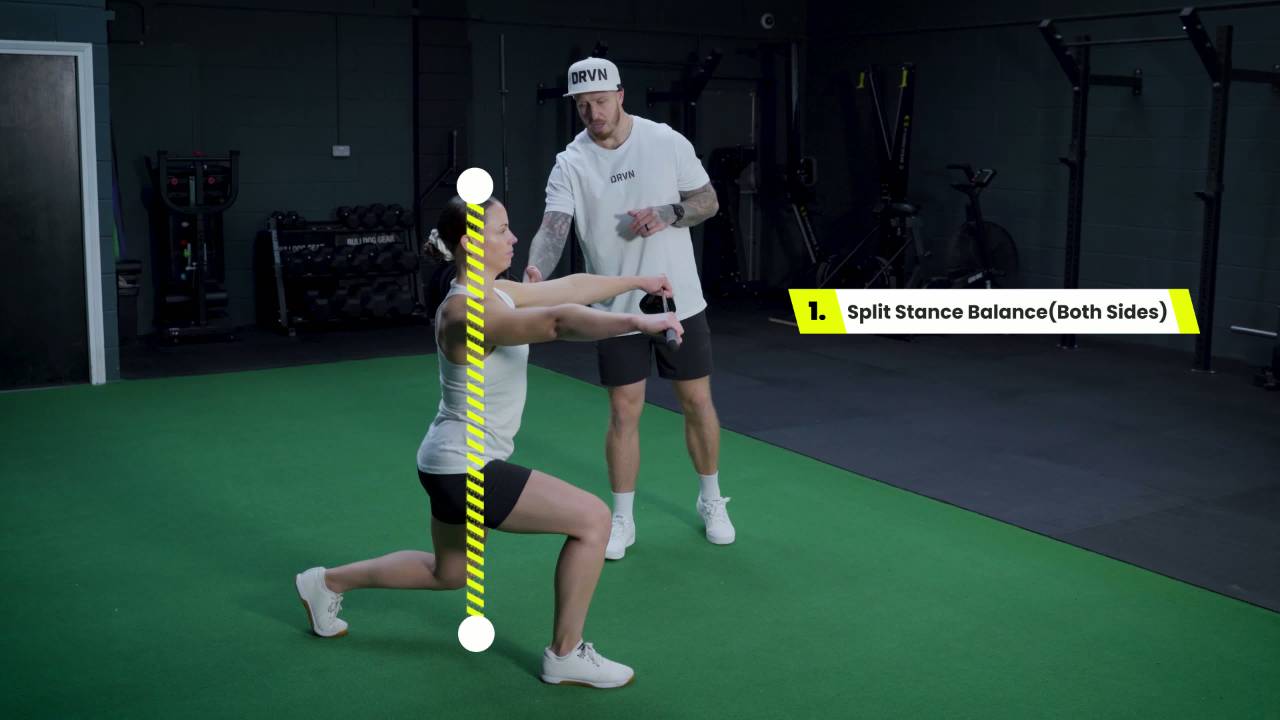
Golf coaches have talked about the X-Factor for decades — the differential between hip and shoulder rotation that creates power in the swing. But for most coaches, it has remained a concept rather than a measurement. Something you observe in a swing, not something you screen for in a physical assessment.
The Split Stance Rotation Test changes that. Part of the DRVN Golf Fitness Handicap™ Mobility Assessment series, it is specifically designed to assess separation — the ability to move the upper and lower body in different directions simultaneously — alongside hip rotation capacity, core activation under load, single-leg stability, and the ability to apply force at the point it matters most: impact.
This free resource breaks down every dimension of the test and explains precisely why each one connects to golf performance. If separation is the engine of power in your golfer's swing, this is how you find out how much engine they actually have.
Separation: The Physical X-Factor
In golf biomechanics, separation refers to the differential between the rotation of the lower body and the rotation of the upper body at the top of the backswing. The greater the separation — the more the torso has rotated relative to the hips — the greater the stretch placed across the trunk musculature, and the more force potential is stored in the system for the downswing.
This is not a technical concept. It is a physical one. A player cannot create separation they don't have the mobility and stability to produce. No swing thought achieves it. No technical drill unlocks it if the body isn't capable of executing it.
"This is the X-Factor of the swing, literally. The ability to move the upper and lower body in different directions increases stretch and force potential through sequencing and range."
The Split Stance Rotation Test isolates this quality in a controlled, observable, bilateral assessment. It tells coaches exactly how much separation a player has available — and where the physical limits are.
What the Test Is Actually Measuring
The test uses a split stance position — one foot forward, one back, mimicking the asymmetric loading of the golf swing — while the player rotates their upper body against a stable lower body. This position makes it impossible to hide mobility restrictions or stability deficits. Six physical qualities are assessed simultaneously:
Separation
The central measure of the test. Coaches observe how far the upper body can rotate relative to the lower body — and whether the lower body stays controlled while the upper body moves. When a player can separate effectively, they can sequence properly and create a swing arc that delivers consistency and the desired impact outcome. When separation is restricted, power potential drops, sequencing breaks down, and compensations appear throughout the swing.
Hip Rotation — Internal and External
The split stance position loads the hips asymmetrically — just as the golf swing does. Both internal and external hip rotation are required for a healthy, powerful, and consistent golf swing. The test reveals whether the player has active control of both ranges. Restrictions in internal hip rotation on the trail side limit backswing depth. Restrictions in lead-side hip rotation limit the ability to clear the hips in the downswing and follow-through, often forcing compensations higher up the chain. Active control — not just passive range — is what the test is evaluating.
Core Activation
The core is the bridge between ground force and upper body rotation. It must be active and stable to effectively and efficiently transfer force from the ground, through the legs, and into the upper body. The split stance position makes core demand explicit — the player cannot complete the test with good form without maintaining a stable, engaged trunk throughout the full range of motion. Coaches look for control and positioning quality throughout the movement, not just at end range. A player whose trunk collapses or shifts during the rotation is showing a force transfer leak that will appear in their swing under load.
Asymmetry — Single-Leg Stability
Single-leg stability is huge in the golf swing due to the asymmetric nature of the movement. The split stance creates a single-leg loading demand on the lead foot — and the quality of ground connection in that position is the foundation for all the rotational movement above it. Enhanced balance and connection to the ground in split stance directly predicts a player's ability to stabilise the lead side through impact, resist early extension, and transfer force efficiently into the follow-through. The test reveals bilateral differences in this quality — right foot forward versus left foot forward — giving coaches a direct read on which side needs prioritised stability work.
Force Application
The final dimension the test illuminates is force application — the ability to take all of the ground force, stretch, load, and power potential built during the backswing and deliver it into the club as the player approaches impact. This is the conversion moment in the golf swing: all the physical capacity built through the coil-uncoil mechanism, the kinematic sequence, and the ground reaction forces either gets applied efficiently or it leaks. The split stance rotation test, by isolating the position and demands of the downswing transition, gives coaches a preview of how effectively a player can execute that conversion.
Separation Under Asymmetric Load
Unlike the Windmill Rotation Test, which assesses rotation in a bilateral wide stance, the split stance creates an explicitly asymmetric loading environment — the same environment the golf swing creates on every shot. This means the separation quality being assessed here is closer to what the swing actually demands. A player who shows reasonable rotation in a bilateral position but collapses under split stance load has a specific functional deficit that won't show up in a standard rotational screen. The Split Stance Rotation Test is designed to surface exactly this.
What Separation Deficits Look Like in the Swing
When the Split Stance Rotation Test reveals restricted separation, limited hip rotation, or unstable core activation, coaches can predict the following swing patterns with high confidence:
- Limited backswing depth with early hip turn — the lower body rotates to compensate for the upper body's inability to separate, reducing coil and power potential
- Over-the-top downswing — without sufficient separation, the player cannot initiate the downswing correctly from the lower body, forcing the upper body to lead and producing an out-to-in club path
- Loss of lag and early release — poor force application through the transition, often rooted in inadequate core stability and separation capacity, causes the player to release the club early and lose club head speed
- Lead-side hip restriction — blocked follow-through, inability to clear the hips, and a tendency to fall back through impact
- Trail-side internal hip restriction — reduced ability to load the backswing, narrower arc, and less rotational coil available for the downswing
- Trunk instability under rotation — inconsistent ball striking, variable impact position, and difficulty repeating the same swing pattern shot to shot
Each of these is a physical finding first. The Split Stance Rotation Test makes the physical evidence visible — giving coaches the data they need to intervene at the source rather than the symptom.
How This Fits the DRVN Golf Fitness Handicap™ Assessment Series
The Split Stance Rotation Test sits alongside the Single Leg Balance Test, Glute Activation Test, Bodyweight Squat Test, and Windmill Rotation Test in the DRVN Golf Fitness Handicap™ Mobility Assessment series. Together, these screens give coaches a comprehensive physical picture of a golfer:
- Balance, proprioception, and single-leg stability (Single Leg Balance Test)
- Posterior chain function, glute activation, and hip hinge capacity (Glute Activation Test)
- Global movement organisation, posture, range of motion, and thoracic mobility (Bodyweight Squat Test)
- Bilateral thoracic rotation range and rotational symmetry (Windmill Rotation Test)
- Separation, hip rotation control, core activation, and force application under asymmetric load (Split Stance Rotation Test)
No single test tells the full story. Together, these five assessments give coaches the objective data foundation to build programming that addresses the right physical qualities in the right order — and to track meaningful progress over time through the Golf Fitness Handicap™.
Who This Ebook Is For
- Fitness coaches who want a functional, golf-specific rotational assessment that evaluates separation, hip rotation, core stability, and asymmetric loading simultaneously
- Golf instructors who want to understand why a player can't produce separation in their swing — and whether targeted physical work, rather than more technical instruction, is the intervention that will actually move the needle
- Any coach working within the DRVN Golf Fitness Handicap™ framework who wants to complete the Mobility Assessment series with the most swing-specific rotational screen in the suite
This resource is also part of the prerequisite curriculum for the DRVN Certified Pro™ credential — the professional standard for coaches who integrate golf fitness and performance at the highest level.
What You'll Be Able to Do After Reading It
- Administer the Split Stance Rotation Test as a structured, bilateral assessment within the DRVN Golf Fitness Handicap™
- Evaluate separation quality, hip rotation range, core activation, and single-leg stability under asymmetric rotational load
- Identify left-right asymmetries in split stance stability and hip rotation and connect them to specific swing compensation patterns
- Use the test findings alongside the full Mobility Assessment series to build a complete physical profile of each golfer client
- Communicate the X-Factor concept to golfer clients in physical, measurable terms — and show them exactly what needs to improve to unlock more power and consistency
"When the player can separate effectively they can also sequence and create a swing arc that brings consistency and desired outcomes."
Download the Free Ebook
Improving Golf Swing Mobility with the Split Stance Rotation Test is free. It is the final assessment in the DRVN Golf Fitness Handicap™ Mobility Assessment series — and the one most directly tied to the power and sequencing qualities that separate good golfers from great ones.
If your golfer clients are leaving power on the table — if they're practising hard but not generating the separation and force application their swing needs — this assessment will show you exactly why.
Measure the separation. Train the X-Factor. Apply the force.
Related Articles
Understanding Golf Ball Measurements for Applied Progressions — Free Ebook
Most fitness coaches never look at the ball. DRVN Certified Pros do. Download this free ebook to learn how ball flight data connects to physical training protocols — and how to coach golfers at a higher level.
Read
Understanding Golf Club Measurements for Applied Progressions — Free Ebook
Club head speed is a body problem. Download this free ebook to learn how club data connects to physical training — and how to use swing metrics to build faster, more accurate progressions for your golfer clients.
Read
Understanding Golf Swing Biomechanics to Build a New Swing Concept — Free Ebook
How ground reaction forces, kinematic sequencing, and the coil-uncoil mechanism create a faster, more consistent golf swing — with a free ebook guide.
Read