
The Golf Swing Is Asymmetrical. Your Assessment Should Be Too. — Free Ebook
The Windmill Rotation Test measures thoracic rotation, lower body stability under rotation, and — critically — the symmetry of rotational capacity between sides. Download this free DRVN ebook to learn how rotational asymmetry shows up in the swing, how to measure it, and what to do about it.
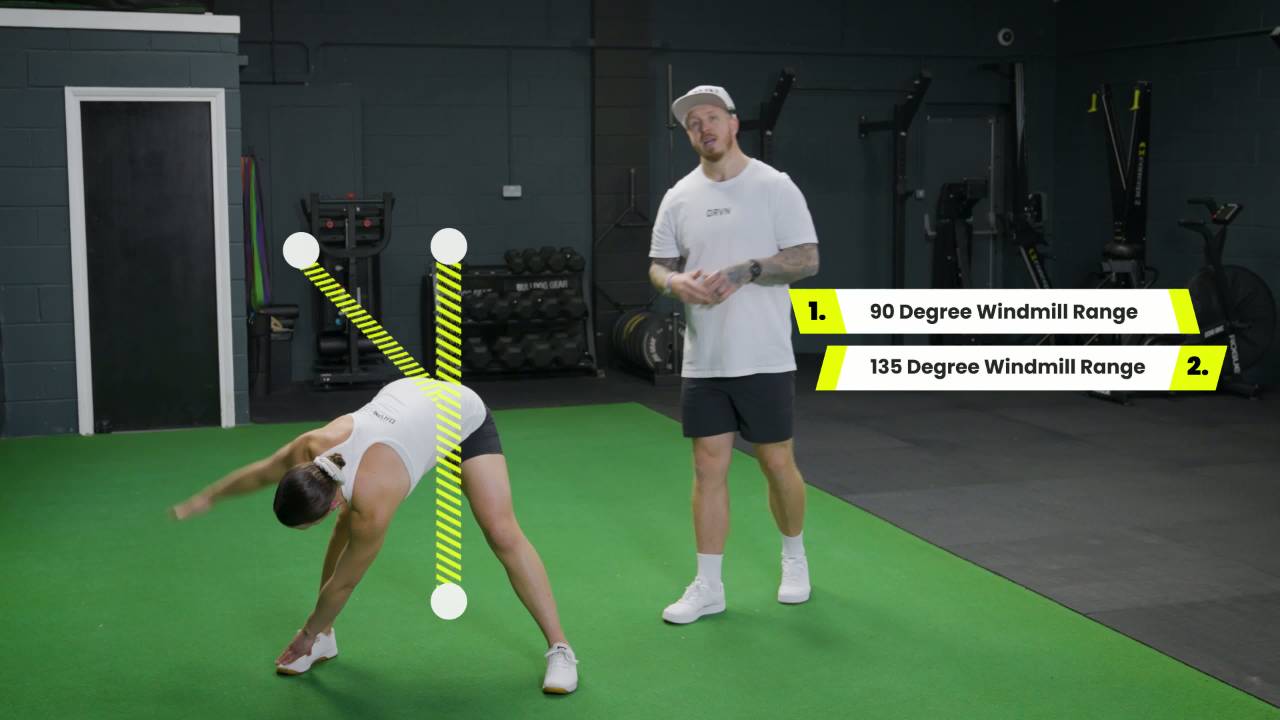
Every golfer rotates. But very few golfers rotate the same amount in both directions — and that difference is one of the most overlooked performance and injury variables in the game.
The Windmill Rotation Test is the rotational assessment in the DRVN Golf Fitness Handicap™ Mobility Assessment series. It measures thoracic rotation range of motion, lower body stability under rotation, center of gravity control, and — critically — the symmetry of rotational capacity between the right and left sides of the body. Each of those qualities connects directly to swing power, consistency, and longevity.
This free DRVN resource breaks down the test, the findings, and the implications for coaching. If you work with golfers, rotational asymmetry is almost certainly showing up in their swing. This is how you find it — and what to do about it.
Golf Is an Asymmetrical Sport. Assess It That Way.
The golf swing rotates the body in one primary direction. Day after day, round after round, the same muscles are loaded, the same segments are compressed, and the same rotational pattern is repeated. Over time, this creates measurable asymmetry in rotational capacity between sides — tighter in one direction, more mobile in the other.
This is normal. The vast majority of golfers will have some degree of rotational imbalance. The problem isn't the asymmetry itself — it's not knowing it exists, not quantifying how significant it is, and not addressing it in training. Left unmanaged, rotational asymmetry leads to compensations in the swing, restricted backswing or follow-through, and elevated risk of overuse injury in the spine, hips, and shoulders.
"The golf swing is an asymmetrical motion and as such the vast majority of golfers will have some imbalances. Understanding this will increase progressions and longevity."
The Windmill Rotation Test makes this measurable. It gives coaches an objective read on how much rotation a player has available in each direction — and how big the gap between sides is. That data directly informs programming priorities and sets a clear, trackable improvement target.
What the Test Is Actually Measuring
The Windmill Rotation Test assesses five interconnected physical qualities through a standing rotational movement performed in a wide stance:
Thoracic Rotation
The thoracic spine is the primary driver of upper body rotation in the golf swing. High quality thoracic rotation — with full, unrestricted range of motion in both directions — is one of the most important physical factors for a golfer's rotational potential. The Windmill test directly loads and measures this quality. Removing thoracic restriction through targeted mobility work enhances performance and reduces injury risk across all levels of the game. A player who cannot achieve adequate thoracic rotation will compensate — typically by over-rotating the lumbar spine, which is both a performance limiter and a significant injury risk.
Body Symmetry — The Core Diagnostic
Rotational symmetry is the standout finding of this assessment. The test measures rotation in both directions and compares the result — giving coaches an objective left-right differential. A player with 50 degrees of rotation to the right and 35 degrees to the left has a meaningful asymmetry that will show up in their swing, whether as a restricted backswing, a limited follow-through, or a compensatory movement pattern that masks the restriction. Identifying this asymmetry with data — not observation alone — allows coaches to design targeted interventions rather than general mobility work.
Neutral Hips — Lower Body Stability Under Rotation
The wide stance of the Windmill test is deliberate. It loads the hips and challenges the player to maintain a neutral lower body position while the upper body rotates. Retaining hip neutrality demonstrates the same quality the golf swing demands: the ability to separate upper and lower body rotation, stabilise the pelvis against rotational forces, and keep the lower body as the anchor while the torso coils above it. A player whose hips rotate excessively with their torso is showing a stability deficit that will compromise their separation, their power coil, and their sequencing in the swing.
Centre of Gravity Control
Rotating around the spine within the base of support is a fundamental movement pattern of the swing — and it is directly testable with the Windmill. The test requires the player to rotate through a full range of motion while keeping their mass controlled within the space between their feet. Any loss of centre of gravity — swaying laterally, shifting weight outside the base of support, or losing balance during the rotation — signals the same deficit that produces inconsistent impact position and a wandering bottom of the arc in the swing.
Power Potential Through Rotational Freedom
Unrestricted thoracic rotation is not just a mobility quality — it is a direct power variable. With full range of motion through thoracic rotation, a golfer increases their power potential through three mechanisms: a wider club arc in the backswing, a deeper rotational coil, and more effective loading of the torso against the trail leg. The Windmill test quantifies how much of this rotational range is actually available — and how much more could be unlocked with targeted mobility training.
What Rotational Restriction Looks Like in the Swing
Coaches who understand the Windmill findings can translate them directly into swing observations — and more importantly, into physical interventions that address the root cause rather than the symptom:
- Restricted thoracic rotation to the right (trail side) — limited backswing shoulder turn, narrow swing arc, reduced coil depth and power potential
- Restricted thoracic rotation to the left (lead side) — limited follow-through freedom, blocked release, tendency to hang back through impact
- Significant left-right asymmetry — inconsistent swing patterns, one-sided overload, elevated injury risk in the spine and lead hip over time
- Hip rotation during the Windmill — inability to separate upper and lower body, loss of kinematic sequencing, reduced power from the coil-uncoil mechanism
- COG drift during rotation — inconsistent swing centre, variable impact position, poor shot-to-shot repeatability
None of these are swing faults in the traditional sense. They are physical expressions of physical restrictions — and the Windmill test gives coaches the data to prove it.
Why Symmetry Is a Longevity Issue, Not Just a Performance Issue
There is a longer-term dimension to rotational asymmetry that coaches who work with golfers need to understand. Golf is a sport played over decades. A golfer who plays three rounds a week for thirty years will make hundreds of thousands of asymmetric rotational movements. A meaningful imbalance in rotational capacity that goes unaddressed doesn't stay static — it compounds.
The tissues on the restricted side become progressively tighter. The compensating tissues on the other side become progressively overloaded. Injury risk accumulates quietly — until it surfaces as a back injury, a hip issue, or a shoulder problem that sidelines the player for months.
Identifying and addressing rotational asymmetry early — through the Windmill test and targeted mobility programming — is one of the highest-leverage interventions a golf fitness coach can make. It improves performance now and protects the player's ability to keep playing long-term.
Who This Ebook Is For
- Fitness coaches who want an objective, bilateral rotational assessment that measures thoracic range of motion, lower body stability, and rotational symmetry simultaneously
- Golf instructors who want to understand why a player's backswing or follow-through appears restricted — and whether the cause is physical rather than technical
- Any coach working within the DRVN Golf Fitness Handicap™ framework who wants to understand the Windmill test's full diagnostic value and how asymmetry findings inform programming
This resource is also part of the prerequisite curriculum for the DRVN Certified Pro™ credential — the professional standard for coaches who integrate golf fitness and performance at the highest level.
What You'll Be Able to Do After Reading It
- Administer the Windmill Rotation Test as a structured, bilateral mobility assessment within the DRVN Golf Fitness Handicap™
- Measure rotational range of motion in both directions and calculate a meaningful left-right differential
- Identify thoracic restriction, hip instability under rotation, and COG control deficits — and connect each finding to specific swing patterns
- Use rotational asymmetry data to prioritise targeted mobility programming and set measurable improvement targets
- Explain to golfer clients how their rotational capacity directly affects their power potential, backswing depth, and long-term physical longevity in the sport
"Unrestricted rotation allows a golfer to create a full, loaded, wide backswing — enhancing their ability to create optimal swing mechanics and desired impact factors."
Download the Free Ebook
Improving Golf Swing Mobility with the Windmill Rotation Test is free. It is part of the DRVN Golf Fitness Handicap™ Mobility Assessment series — a suite of physical screening resources that give coaches the objective data they need to build smarter, more targeted golf performance programmes.
Rotation is the engine of the golf swing. The Windmill test tells you how much of that engine your golfer is actually using — and how symmetrically they're using it.
Measure the rotation. Address the asymmetry. Unlock the power.
Related Articles
Understanding Golf Ball Measurements for Applied Progressions — Free Ebook
Most fitness coaches never look at the ball. DRVN Certified Pros do. Download this free ebook to learn how ball flight data connects to physical training protocols — and how to coach golfers at a higher level.
Read
Understanding Golf Club Measurements for Applied Progressions — Free Ebook
Club head speed is a body problem. Download this free ebook to learn how club data connects to physical training — and how to use swing metrics to build faster, more accurate progressions for your golfer clients.
Read
Understanding Golf Swing Biomechanics to Build a New Swing Concept — Free Ebook
How ground reaction forces, kinematic sequencing, and the coil-uncoil mechanism create a faster, more consistent golf swing — with a free ebook guide.
Read